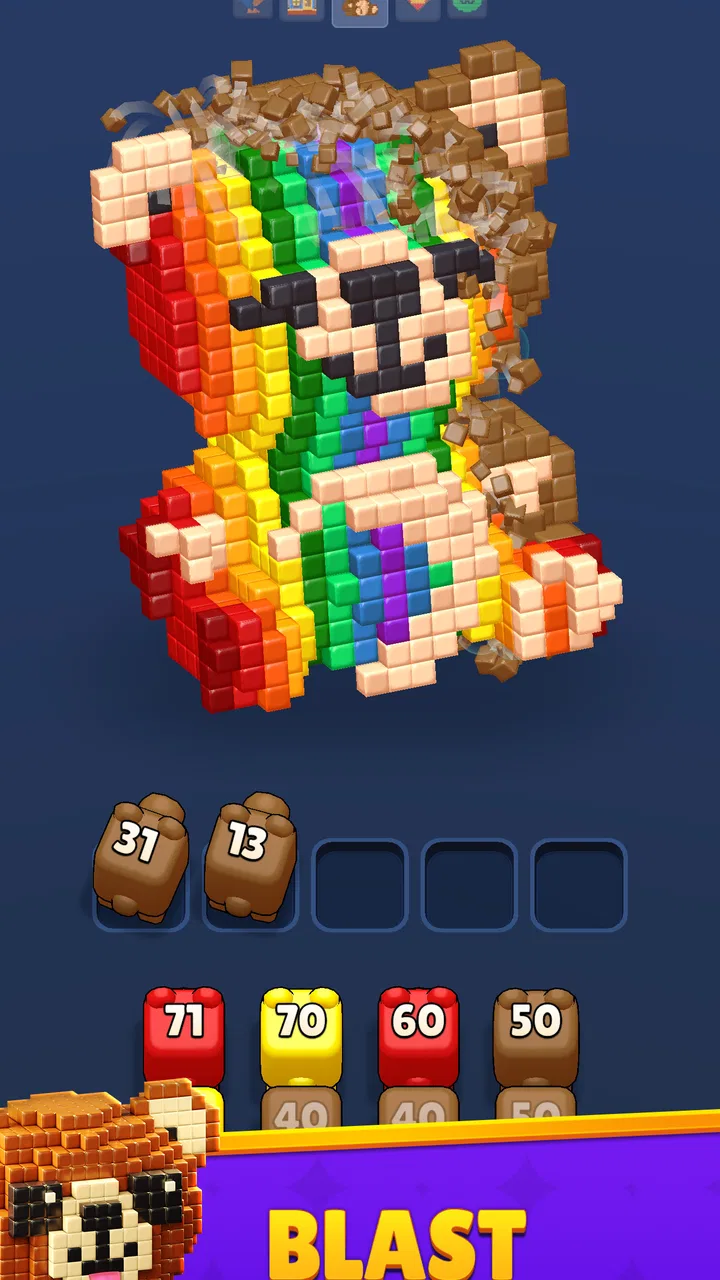
Cube Land Puzzle Game
- 4.5
- Rating
- 1.00M
- Installs
- Free
- Price

 Analysis by App-foxy
Cube Land is a free puzzle game from Rotatelab Yazilim ve Bilisim A.S. that caught my attention because it asks for planning rather than frantic tapping. Its store summary, “Plan Smart. Blast Big.”, gives a fair impression of the intended mood, but it does not explain the small decisions that determine whether a session feels satisfying or confusing. After spending time with it, I see a compact game built around arranging cube-based moves carefully, recognizing patterns, and resisting the temptation to use a promising action too early.
The game is listed as Cube Land, and its short store description is simply “Cube Land.” That minimal presentation makes the first few minutes important: you have to learn the visual language through play instead of relying on a long explanation. I found that approachable, although players who prefer a detailed tutorial may feel that the opening leaves them to discover the rhythm on their own.
What makes the puzzle loop work
At its best, Cube Land gives me a clear little problem to solve without demanding a long commitment. I can open it for a short break, study the board, make a move, and decide whether to continue. The appeal is not just clearing something immediately; it is weighing the current move against the shape of the board that will remain afterward. That makes the game more thoughtful than a simple matching exercise.
You May Also Like

 Blood Strike: 2.5 Anniversary
Blood Strike’s Loadouts Turn Every Drop Into a Tactical Gamble
A close look at Blood Strike’s custom loadouts: how fast access to signature weapons reshapes its battle royale rhythm, rewards preparation, and narrows the gap between fights.

 Pandora - Music & Podcasts
Pandora’s Music Is Easy to Start, but Harder to Recover
Pandora’s strength is its low-effort path from a seed to a station. Its weak spot is how much confidence it asks you to place in connection, setup, and quiet recovery.

 8 Ball Pool
 Is Built on Rivalries, Rematches, and Routine
A close look at the rivalries, rematches, shared routines, and unanswered safety questions that turn a quick pool match into a persistent mobile community.

 Samsung Music
’s Quiet Strength Is Playing What You Already Own
Its reach comes less from spectacle than from dependable access to a personal library. That simplicity is both the app’s strongest retention engine and its ceiling.

 AccuWeather: Weather Radar
AccuWeather Review: A Quick, Clear Forecast for Everyday Decisions
For everyday plans, the best forecast is the one you can understand quickly. AccuWeather makes rain timing, radar, and local conditions easy to act on, with a few trade-offs.

 Hill Climb Racing
Why Hill Climb Racing Still Turns Crashes Into One More Run
A tiny car, a bumpy hill and one more upgrade: Hill Climb Racing keeps resurfacing because its simple chaos makes every near-miss feel personal.
More From Our News Desk
View All News


The most useful habit is to stop treating every available move as equally valuable. A move that looks large may leave awkward spaces, while a smaller action can preserve room for a better chain later. I began checking the edges and corners before committing to the most obvious cluster. This is one of the game’s quiet strengths: the board encourages me to think one step beyond the move directly in front of me.
I also recommend taking a brief pause whenever several options appear. The game is much easier to read when I scan the whole arrangement first, rather than reacting to the first combination that catches my eye. That approach is especially helpful for new players because it turns the opening moments into a planning exercise instead of a guessing exercise.
Another practical insight is to protect flexible spaces. When the board starts to become crowded, an empty area can be more useful than an immediate clear. Keeping a workable gap gives later pieces or patterns somewhere to fit, while filling every available space can create a position that looks active but has no good follow-up. This is the kind of lesson I only appreciated after a few failed attempts.
Where first-time players can get stuck
The first friction point is understanding what the game considers a strong move. The visual design may make a large group feel automatically correct, but the better choice often depends on what it leaves behind. If you are used to puzzle games that reward instant matches, Cube Land can feel slower at first because it asks you to read the whole arrangement.
I would not judge a session by the first few moves. Early mistakes are useful because they show how quickly an apparently open board can lose flexibility. Instead of restarting immediately, I suggest observing the result of a questionable move and remembering which spaces became difficult to use. That creates a personal strategy faster than trying to memorize a rigid formula.
Players can also get stuck by focusing on one side of the board. I had better results when I alternated between local opportunities and the overall shape. A move near the middle may affect several future options, while a move at the edge can sometimes tidy the board without changing its long-term balance. Looking at both scales helps prevent tunnel vision.
For younger players, the Everyone content rating makes the game broadly accessible, but accessibility does not mean every puzzle will feel effortless. Children who enjoy experimenting may like discovering their own methods. Players looking for a completely relaxed game with no need to reconsider choices may prefer a simpler matching title instead.
Setup checks before blaming the game
Cube Land is free to install, which makes it easy to try without a purchase decision at the start. The listed version is 0.2.5, and the minimum operating-system requirement is Android 7.0. Before troubleshooting a launch or update problem, I would first check that the device meets that requirement and has enough free space for an installation and its temporary files.
If the game does not open correctly, my first routine is deliberately simple: close other demanding apps, restart the device, and try again. I would also confirm that the installation completed normally rather than assuming a stalled download is a gameplay problem. These checks sound basic, but they separate a device or installation issue from a problem inside the puzzle itself.
When an update appears unavailable, I would check the app store account and the device’s connection before repeatedly tapping the update button. A weak connection, a full storage area, or a store process that needs refreshing can all make a game appear older than expected. I prefer to solve those conditions first because deleting and reinstalling should be a later step, not the opening move.
There is also a practical reason to avoid unnecessary reinstalling: any locally held progress or preferences may not return unless the game itself preserves them. I would only remove the app after considering whether that could affect a current session. This is not a criticism unique to Cube Land; it is a sensible precaution for any puzzle game where a player has invested time in a run.
Recovering a session that has gone wrong
When a puzzle position becomes difficult, I do not immediately assume the game has failed. First I look for whether the board is genuinely blocked or whether I have overlooked a smaller legal move. Zooming in mentally, scanning from one edge to the other, and checking isolated spaces can reveal an option that is easy to miss when I am focused on a large group.
If the interface stops responding, I would wait briefly, avoid repeated taps, and then close and reopen the game if necessary. Repeated input can make it harder to tell whether a move registered. After reopening, I would check the board carefully before making another action. This recovery approach is safer than rapidly pressing several locations and then trying to reconstruct what happened.
A useful workflow is to treat each move as a checkpoint for your thinking. Before tapping, identify the space you are trying to preserve and the result you expect. After tapping, compare the actual board with that expectation. If the result differs, slow down and re-read the visual cues instead of continuing on autopilot. This method reduces frustration and helps reveal whether the issue is a misunderstood rule or a genuine input problem.
I also found that changing the pace improves accuracy. Quick taps are tempting when a pattern looks obvious, but a deliberate rhythm gives me time to confirm the target. That matters most in crowded positions, where a small visual detail can change the value of a move. Cube Land rewards attention more than speed, so playing it like an action game works against its strongest quality.
When the app may not be the cause
Not every poor session points to a defect. A puzzle can feel unfair when the real issue is that I committed too early or stopped looking at the remaining space. Before deciding that the game generated an impossible situation, I would replay the sequence mentally and ask whether a more conservative move could have kept the board open.
Performance can also be affected by the phone rather than the game. If other apps are struggling, the device is hot, or storage is nearly full, I would test Cube Land after closing background activity and restarting. If the problem disappears, the game may simply have been sharing limited resources. If the same behavior remains only in this title, then it becomes more reasonable to investigate the installation or report the issue through the normal store channel.
Input problems deserve the same distinction. A screen protector, damp fingers, or an unresponsive area of the display can make a tap appear inaccurate. I would test several parts of the screen and compare the behavior in another app before concluding that Cube Land is misreading every move. That small check can save a lot of unnecessary troubleshooting.
Connection conditions may matter during installation or updates, but I would not assume that every pause during play is a network failure. A brief wait can come from the device, the store process, or the game handling a transition. The sensible order is to check the connection, restart the app, and then repeat the same action once rather than making several changes at once.
Who will enjoy it most
Cube Land suits players who like compact strategy puzzles and enjoy improving through observation. It is a good fit for someone who wants a game that can occupy a short break but still rewards careful thinking. I especially recommend it to people who naturally ask, “What will this leave behind?” rather than only, “What can I clear right now?”
It also works well as a low-pressure mental reset. In an everyday scenario, I might open it while waiting for an appointment, play a few deliberate moves, and stop before the session becomes a commitment. The board gives me something concrete to focus on, and the short-loop structure is easier to fit into a busy day than a larger adventure or story game.
On the other hand, I would skip it if you want a puzzle game built around a strong narrative, competitive interaction, or constant action. Cube Land’s appeal comes from its board decisions, not from a broad feature set that I would expect in a role-playing game or an online competition. Players who need explicit instructions for every rule may also need patience during the learning phase.
The game has an average rating of 4.3 from around 2.1 thousand ratings, with more than a hundred written reviews and over 100 thousand installs. Those figures suggest that it has found an audience, but they should not replace personal testing. The most important question is whether you enjoy its planning rhythm, because that determines the experience more than its popularity.
How it compares with familiar puzzle alternatives
Compared with a traditional match-three game, Cube Land feels more spatial and less dependent on making the fastest visible match. Match-three titles are often better when I want bright feedback and immediate momentum. Here, I get more value from studying the arrangement and preserving future possibilities. That makes Cube Land calmer, but also less forgiving when I play carelessly.
Compared with a pure block-placement puzzle, it offers a different kind of tension. Block games often make the next shape the central concern, while Cube Land puts more emphasis on the current arrangement and the consequences of clearing or positioning. If you enjoy planning around limited space, this distinction can be refreshing. If you prefer a predictable sequence of falling pieces, the format may feel less familiar.
It is also less suitable than a casual matching app for someone who wants to play entirely on instinct. I can use instinct for the opening, but stronger sessions come from slowing down and considering the board’s future shape. That trade-off is important: the game is more mentally engaging than a purely automatic time-killer, yet it asks for attention when I may only want background entertainment.
Cost, progression, and everyday expectations
The game is free, with in-app purchase items ranging from $0.99 to $99.99 per item. I would approach those purchases cautiously and decide first whether the core loop is enjoyable without spending. For a puzzle title of this kind, the best test is simple: play enough to learn the decision-making rhythm, then judge whether any optional purchase genuinely improves your experience rather than buying out of frustration.
Because the game is still presented as a relatively early version, I would keep expectations practical. Version 0.2.5 suggests that the experience may continue to change, so a player who enjoys trying a developing puzzle can find that appealing. Someone who wants a fully settled game with years of accumulated polish may be happier with a long-established alternative.
My strongest practical recommendation is to create a personal rule before playing: preserve space first, chase a large clear second. That single change makes the board easier to read and reduces the number of sessions that collapse because of one attractive but short-sighted move. I would also stop after a frustrating run and return later, since fatigue makes the game’s visual decisions harder to judge.
My practical verdict
Cube Land is worth trying if you want a free, deliberate puzzle game that rewards planning over reflexes. I like that its central challenge can fit into a short break while still giving me something to think about. The most satisfying moments come when a modest move preserves the board and creates a stronger opportunity later.
Its limitations are equally clear. The opening may require self-directed learning, crowded positions can be easy to misread, and players seeking story, competition, or constant action will find a better match elsewhere. The purchase range also means I would keep spending optional and controlled rather than treating it as part of the basic test.
For me, the deciding factor is the balance between simplicity and consequence. Cube Land does not need a complicated presentation to make a move matter. If you enjoy examining a board, recovering from a poor decision, and gradually learning which spaces are worth protecting, I would recommend giving it a careful try. If you want instant matches with almost no planning, choose a more reactive puzzle instead.
Rotatelab Yazilim ve Bilisim A.S. has made a game that is easiest to appreciate when played patiently. I would install it for short sessions, check the device requirements before troubleshooting, and judge it by the quality of its decisions rather than by how quickly I can clear the board. That is where its real appeal lies.
FAQs for Cube Land Puzzle Game
01What is Cube Land Puzzle Game?
Cube Land Puzzle Game is an engaging and challenging puzzle game available for both Android and iOS. It features a series of intricate 3D puzzles that require strategic thinking and spatial awareness to solve. Players manipulate cubes within a grid to reach a designated goal, making it a perfect game for puzzle enthusiasts.
02Is Cube Land Puzzle Game suitable for all ages?
Yes, Cube Land Puzzle Game is designed to be family-friendly and suitable for players of all ages. The intuitive controls and gradual increase in difficulty make it accessible for younger players, while the complex puzzles offer a challenge for adults. However, it’s always recommended for parents to review the game content.
03Does Cube Land Puzzle Game require an internet connection?
Cube Land Puzzle Game can be played offline, making it a great option for on-the-go gaming without the need for a constant internet connection. However, some features, such as leaderboards or in-game purchases, might require an internet connection to function properly.
04Are there any in-app purchases in Cube Land Puzzle Game?
Yes, Cube Land Puzzle Game offers optional in-app purchases. These can include additional puzzle packs, hints, or cosmetic items to enhance the gaming experience. While the game can be enjoyed without spending money, these purchases can provide additional content and support the developers.
05How does Cube Land Puzzle Game handle user data and privacy?
Cube Land Puzzle Game takes user privacy seriously. It collects minimal data necessary for gameplay and adheres to privacy regulations. Players can review the app’s privacy policy, usually available in the app settings or the app store listing, to understand what data is collected and how it is used.
Pros
- Engaging and challenging puzzles.
- Intuitive and user-friendly interface.
- Vibrant graphics enhance gameplay.
- Regular updates with new levels.
- Minimal ads for uninterrupted play.
Cons
- Limited free hints available.
- In-app purchases are pricey.
- Can be resource-heavy on older devices.
- Occasional lag with complex puzzles.
- No multiplayer or social features.

Cube Land Puzzle Game
Gallery